Black Holes
A black hole is a region of spacetime where gravity is so strong that nothing, including light or other electromagnetic waves, has enough energy to escape its event horizon. The theory of general relativity predicts that a sufficiently compact mass can deform spacetime to form a black hole. The boundary of no escape is called the event horizon.
Although it has a great effect on the fate and circumstances of an object crossing it, it has no locally detectable features according to general relativity. In many ways, a black hole acts like an ideal black body, as it reflects no light.
Moreover, quantum field theory in curved spacetime predicts that event horizons emit Hawking radiation, with the same spectrum as a black body of a temperature inversely proportional to its mass. This temperature is of the order of billionths of a kelvin for stellar black holes, making it essentially impossible to observe directly.
But how big are the biggest black holes really?
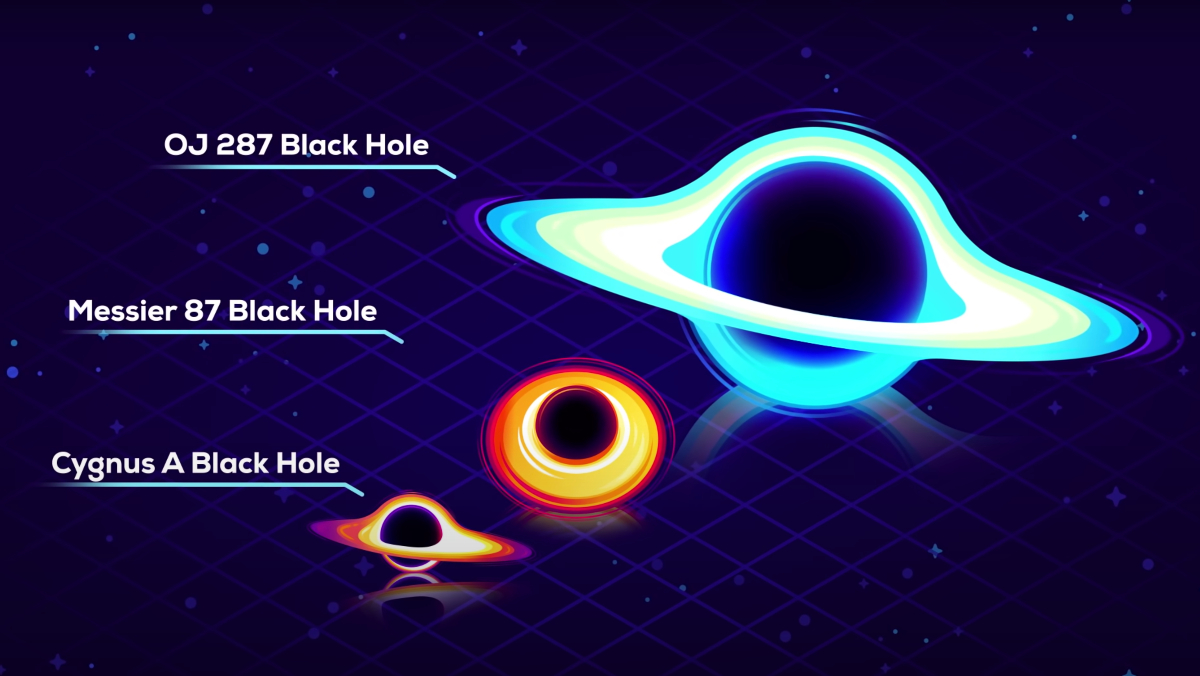
The lineup of the (usual) gravitational suspects begins with black holes that are only the size of protons yet still have the same mass as a big mountain. The comparison then ascends up through black holes around the size of the one that keeps V723 Mon, a star 24 times the mass of the Sun, in orbit. But, that black hole is only 17.2 kilometers—or roughly 10 miles—wide.
From there, the comparison bounds up to black holes that have hundreds of times the mass of the Sun. These seem downright gargantuan until black holes that are millions of times more massive than the Sun. The supermassive black hole at the center of the Milky Way Galaxy, Sagittarius A, is one such monster, even though it only has a radius 17 times larger than the Sun’s.
 using WordPress
Territory not explored yet